From Early AI Research to the World's Most Popular AI Assistant
Introduction
Artificial Intelligence (AI) has transformed the way people work, learn, and communicate. Among the many breakthroughs in AI, ChatGPT stands out as one of the most influential innovations of the 21st century. Since its public launch in November 2022, ChatGPT has changed how students study, businesses operate, marketers create content, developers write code, and professionals solve complex problems.
Today, millions of people use ChatGPT every day for writing, coding, customer support, education, marketing, research, language translation, brainstorming, and much more. However, ChatGPT did not appear overnight. It is the result of decades of research in artificial intelligence, machine learning, natural language processing (NLP), and deep learning.
This article explores the complete history of ChatGPT, from the origins of AI to the latest advancements that continue to shape the future of conversational intelligence.
What is ChatGPT?
ChatGPT is an AI-powered conversational assistant developed by OpenAI. It is based on the Generative Pre-trained Transformer (GPT) family of language models, designed to understand and generate human-like text.
Unlike traditional chatbots that rely on predefined responses, ChatGPT uses deep learning to understand context, answer questions, generate content, summarize information, write code, translate languages, and perform many other language-related tasks.
The Origins of Artificial Intelligence
The story of ChatGPT begins long before the internet became mainstream.
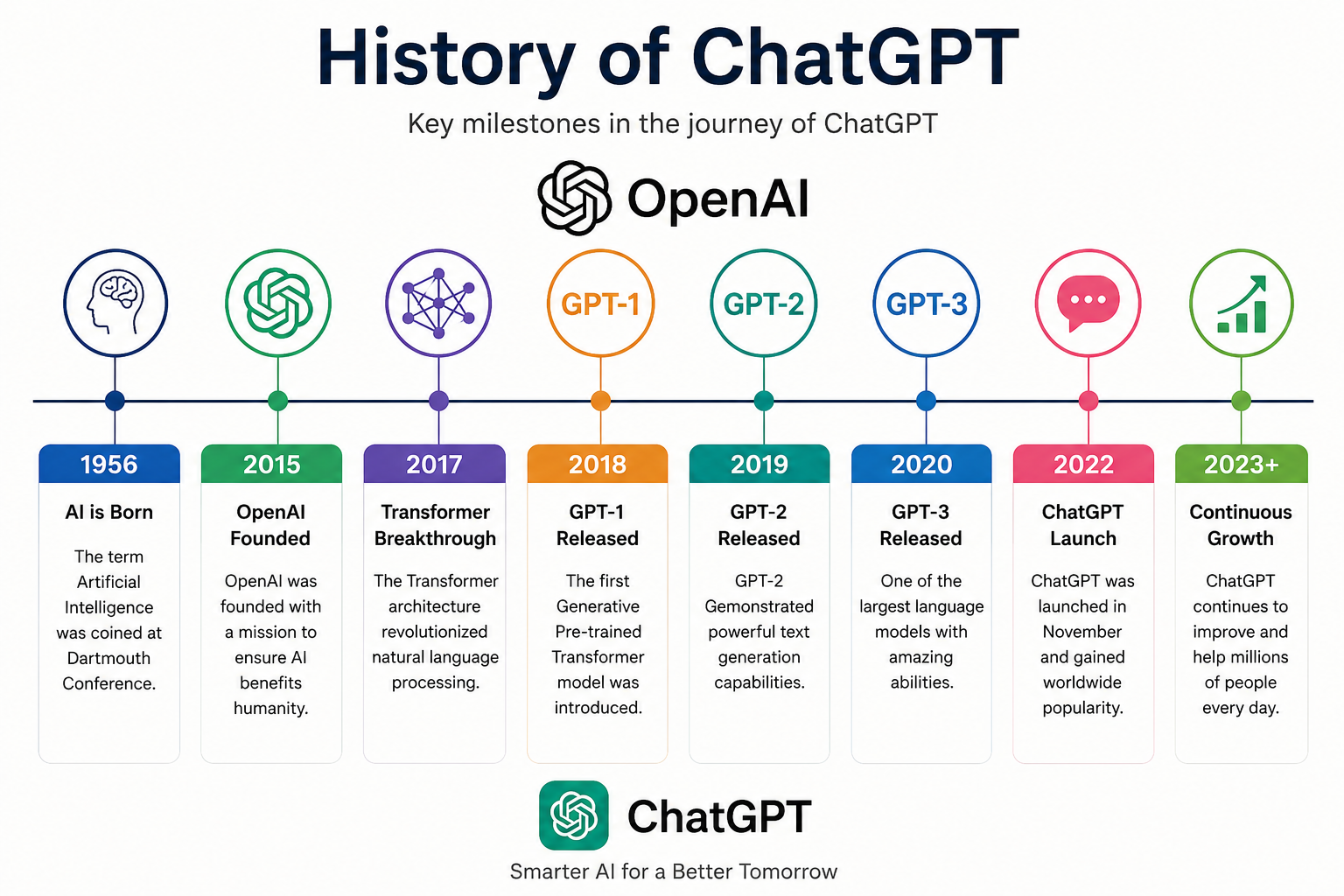
In 1956, researchers officially introduced the term Artificial Intelligence during the Dartmouth Summer Research Project. Scientists believed that computers could eventually perform tasks requiring human intelligence, such as reasoning, learning, and language understanding.
During the following decades, AI experienced periods of rapid progress and setbacks, commonly referred to as "AI winters." Limited computing power and insufficient data slowed development for many years.
The Rise of Machine Learning
By the early 2000s, AI research shifted toward Machine Learning, where computers learn patterns from data instead of relying solely on manually written rules.
The availability of:
- Faster processors
- Large datasets
- Cloud computing
- Graphics Processing Units (GPUs)
allowed researchers to train increasingly sophisticated AI models.
Machine learning laid the foundation for modern AI assistants.
Deep Learning Revolution
Around 2012, deep learning dramatically accelerated AI progress.
Neural networks became capable of:
- Image recognition
- Speech recognition
- Language translation
- Text generation
- Pattern detection
Deep learning models improved rapidly because they could process enormous datasets and discover complex relationships between words and concepts.
The Birth of OpenAI
OpenAI was founded in 2015 with the mission of developing artificial intelligence that benefits humanity.
The organization focused on creating advanced AI systems while emphasizing safety, research, and responsible deployment.
Its researchers began exploring large language models capable of understanding and generating natural language.
The Transformer Revolution (2017)
One of the biggest breakthroughs came in 2017 with the introduction of the Transformer architecture in the research paper Attention Is All You Need.
Transformers revolutionized Natural Language Processing because they could:
- Understand long contexts
- Process text efficiently
- Learn relationships between words
- Scale to massive datasets
Almost every modern language model—including GPT—uses Transformer technology.
GPT-1 (2018)
The first Generative Pre-trained Transformer (GPT-1) demonstrated that a model pre-trained on large amounts of text could perform many language tasks with minimal additional training.
Although GPT-1 was relatively small by today's standards, it proved the effectiveness of generative pre-training.
GPT-2 (2019)
GPT-2 marked a significant leap forward.
It generated surprisingly coherent paragraphs, stories, summaries, and conversations.
Initially, OpenAI released GPT-2 gradually due to concerns about potential misuse, such as automated misinformation and spam.
This highlighted the growing importance of AI safety.
GPT-3 (2020)
GPT-3 became one of the largest language models ever created at the time.
Its capabilities included:
- Writing articles
- Creating poems
- Generating programming code
- Answering questions
- Explaining complex concepts
- Translating languages
- Brainstorming ideas
Businesses quickly recognized GPT-3's potential for customer service, education, marketing, and software development.
InstructGPT (2022)
Although GPT-3 was powerful, it sometimes produced responses that did not align well with user instructions.
To improve helpfulness, OpenAI developed InstructGPT, trained using human feedback through a technique called Reinforcement Learning from Human Feedback (RLHF).
This made responses:
- More accurate
- More conversational
- Better aligned with user intent
- Safer and more helpful
ChatGPT Launch (November 2022)
In November 2022, OpenAI introduced ChatGPT to the public.
Within days, millions of users signed up.
The platform gained popularity because it could:
- Answer questions instantly
- Write essays
- Generate emails
- Create marketing content
- Solve coding problems
- Explain mathematics
- Translate languages
- Assist students
The speed of adoption was unprecedented in technology history.
Why Did ChatGPT Become So Popular?
Several factors contributed to ChatGPT's explosive growth.
Easy to Use
Users simply type questions in natural language.
High-Quality Responses
The AI produces detailed, context-aware answers.
Multiple Use Cases
People use ChatGPT for:
- Business
- Education
- Programming
- Marketing
- Writing
- Research
- Customer support
- Productivity
Continuous Improvements
Regular model updates have steadily improved reasoning, reliability, and multimodal capabilities.
ChatGPT in Education
Students now use ChatGPT for:
- Homework assistance
- Exam preparation
- Research
- Essay drafting
- Language learning
- Programming practice
- Mathematics explanations
Teachers also use it to create lesson plans, quizzes, worksheets, and classroom activities.
ChatGPT in Digital Marketing
Digital marketers use ChatGPT extensively for:
- SEO content creation
- Keyword research ideas
- Meta descriptions
- Google Ads copy
- Facebook Ads
- Instagram captions
- Email marketing
- Blog writing
- Product descriptions
- YouTube scripts
It significantly reduces content creation time while helping marketers brainstorm and refine ideas.
ChatGPT for Businesses
Companies integrate ChatGPT into:
- Customer support
- Sales automation
- CRM workflows
- HR assistance
- Employee training
- Internal documentation
- Data analysis
- Knowledge management
Organizations use AI to improve efficiency while allowing employees to focus on higher-value tasks.
ChatGPT for Developers
Software developers rely on ChatGPT to:
- Generate code
- Debug programs
- Explain algorithms
- Write documentation
- Learn programming languages
- Build APIs
- Optimize software
It acts as a coding assistant that accelerates development workflows.
ChatGPT in Healthcare
Healthcare professionals explore ChatGPT for:
- Medical documentation
- Patient communication drafts
- Research summaries
- Administrative support
However, AI should complement—not replace—qualified medical professionals, especially for diagnosis and treatment decisions.
ChatGPT and Content Creation
Content creators use ChatGPT to produce:
- Blog posts
- Website copy
- Product descriptions
- Social media posts
- Newsletters
- Video scripts
- Podcast outlines
- Marketing campaigns
Human review remains important to ensure originality, accuracy, and alignment with brand voice.
The Evolution Beyond Text
Modern AI systems have expanded beyond text.
New capabilities include:
- Image understanding
- Image generation
- Voice conversations
- File analysis
- Data interpretation
- Real-time collaboration
- Multimodal interactions
These features allow users to work with text, images, audio, and documents in a single interface.
Ethical Challenges
The rapid growth of AI also raises important questions.
Challenges include:
- Accuracy and hallucinations
- Privacy
- Copyright
- Misinformation
- Bias
- Security
- Responsible AI use
Developers, researchers, governments, educators, and businesses continue working on policies and technologies that encourage safe and beneficial AI deployment.
The Future of ChatGPT
The future of conversational AI is expected to include:
- More accurate reasoning
- Better personalization (with user control)
- Smarter business automation
- Improved multilingual communication
- Enhanced collaboration tools
- Stronger educational support
- Advanced coding assistance
- Rich multimodal experiences
AI assistants are likely to become increasingly integrated into daily life and workplace productivity.
Benefits of ChatGPT
- Saves time
- Improves productivity
- Enhances creativity
- Supports learning
- Simplifies coding
- Assists businesses
- Improves customer service
- Accelerates content creation
- Supports multilingual communication
- Helps automate repetitive tasks
Limitations of ChatGPT
Although powerful, ChatGPT has limitations:
- It can make mistakes.
- It may provide outdated or incomplete information if not connected to current sources.
- It should not replace professional advice in legal, financial, or medical matters.
- Human judgment remains essential for important decisions.
Understanding these limitations helps users apply AI responsibly.