Introduction
Digital marketing has become an essential part of modern business growth. From small businesses to large companies, organizations use digital marketing strategies to increase brand awareness, attract potential customers, generate leads, and improve sales. To achieve these goals, marketers use different digital marketing tools that help them analyze performance, manage campaigns, create content, and optimize websites.
Learning the top tools in digital marketing in Digital Marketing training is important for students, business owners, freelancers, and marketing professionals who want to build successful careers in the digital industry. These tools make marketing activities more efficient and help businesses make data-driven decisions.
At Digital Training India, students can learn how digital marketing tools are used in practical marketing activities, including SEO, social media marketing, Google Ads, content marketing, and website optimization.
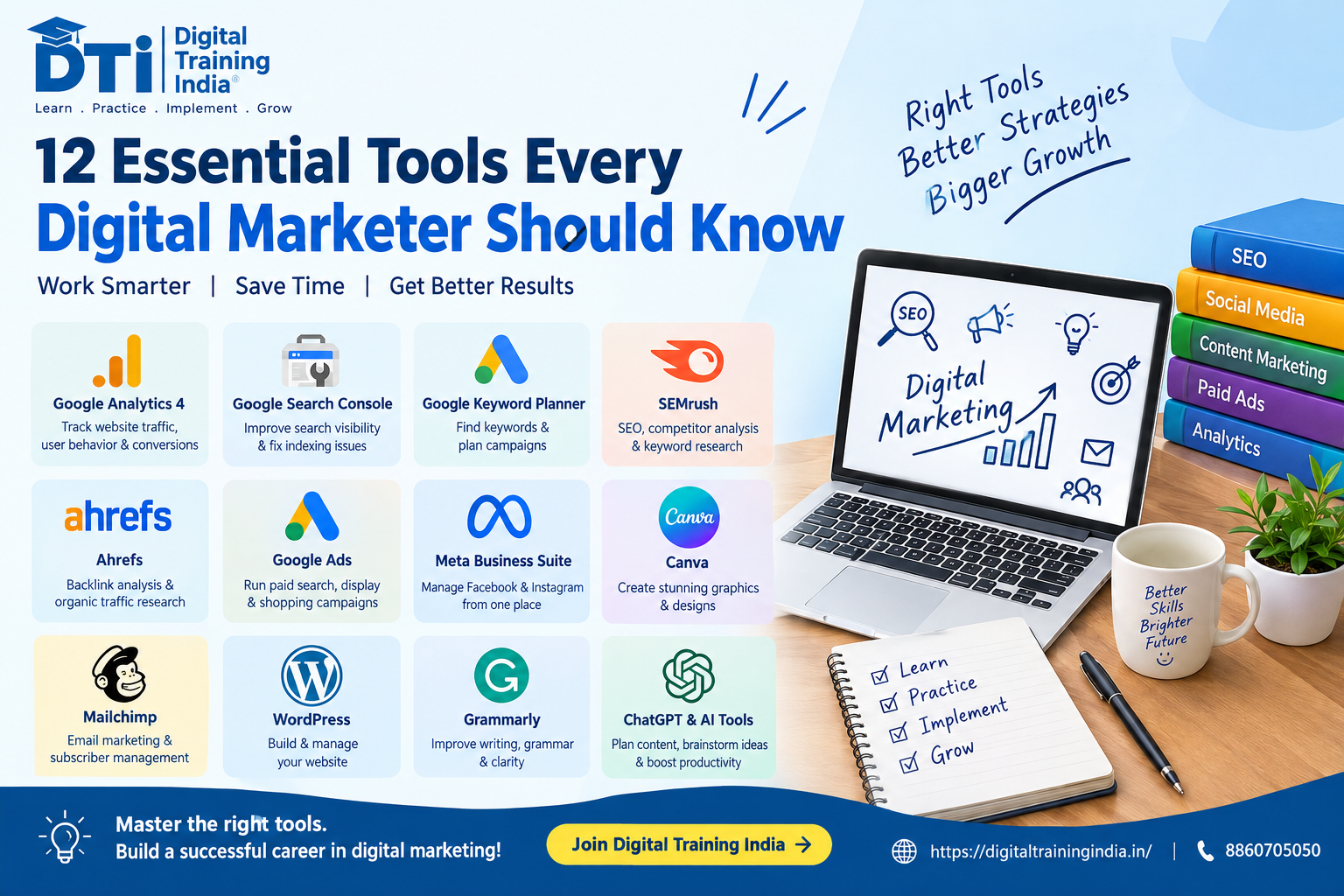
1. Google Analytics 4 (GA4)
Google Analytics 4 is one of the most important tools for tracking website and app performance. It helps digital marketers understand how visitors interact with a website and which marketing channels generate traffic.
Key features of Google Analytics 4:
- Track website visitors and user engagement.
- Analyze traffic sources, including organic search, paid ads, and social media.
- Measure conversions and important user actions.
- Identify high-performing landing pages.
- Understand user journeys and audience behavior.
GA4 is particularly useful for businesses that want to measure the results of their digital marketing campaigns and improve website performance.
2. Google Search Console
Google Search Console is a free tool that helps website owners monitor their website's performance in Google Search. It is especially useful for SEO professionals who want to improve organic visibility.
Benefits of Google Search Console:
- Monitor search impressions, clicks, and average positions.
- Discover which search queries bring visitors to a website.
- Identify indexing and crawling issues.
- Submit XML sitemaps.
- Monitor certain technical SEO issues and website enhancements.
For example, a business targeting the keyword "digital marketing course in Delhi" can use Search Console to understand how its website performs for relevant search queries.
3. Google Keyword Planner
Google Keyword Planner is a keyword research tool available through Google Ads. It helps marketers discover relevant keywords and estimate their search demand and advertising competition.
Its major uses include:
- Finding new keyword ideas.
- Reviewing estimated search volume ranges.
- Understanding advertising competition and bid estimates.
- Planning Google Search advertising campaigns.
- Discovering related keywords for website content.
Keyword research is an important step in SEO and paid advertising because it helps marketers understand what potential customers are searching for online.
4. SEMrush
SEMrush is a popular digital marketing platform used for SEO, competitive research, keyword analysis, and content optimization.
Important features include:
- Keyword research and tracking.
- Competitor website analysis.
- Backlink analysis.
- Website SEO audits.
- Content and search visibility research.
SEO professionals can use SEMrush to identify keyword opportunities, analyze competing websites, and discover areas where their own websites need improvement. Some features require a paid subscription.
5. Ahrefs
Ahrefs is another widely used platform for SEO and backlink analysis. It helps marketers understand website authority signals, analyze competitor backlinks, and research organic search opportunities.
Its key features include:
- Backlink research.
- Competitor keyword analysis.
- Organic traffic research.
- Keyword discovery.
- Website health audits.
Ahrefs can be useful for developing an SEO strategy, identifying content gaps, and discovering potential websites for relevant link-building opportunities.
6. Google Ads
Google Ads is an online advertising platform that enables businesses to promote products and services across supported Google advertising networks.
Digital marketers use Google Ads to reach people who are searching for specific products or services and to build campaigns around business goals.
What can you do with Google Ads?
- Create search advertising campaigns.
- Run eligible display and video campaigns.
- Promote products through supported shopping campaigns.
- Generate leads and website traffic.
- Measure conversions and advertising performance.
For example, a digital marketing institute can create a search campaign targeting people looking for digital marketing training in Delhi. Campaign performance should be evaluated using relevant metrics such as conversion rate, cost per lead, and return on ad spend where applicable.
7. Meta Business Suite
Meta Business Suite helps businesses manage their Facebook and Instagram presence from one place. It is useful for social media marketers who need to organize content, communicate with audiences, and review account performance.
Its features include:
- Scheduling Facebook and Instagram posts.
- Managing messages and comments.
- Reviewing content insights.
- Managing certain business account activities.
- Accessing tools for coordinating social media marketing.
Businesses can use Meta Business Suite to maintain a consistent posting schedule and understand which content attracts audience engagement.
For paid advertising, marketers can also use Meta Ads Manager to create, manage, and optimize advertising campaigns.
8. Canva
Canva is a user-friendly graphic design platform that helps marketers create visual content without requiring advanced graphic design skills.
Canva can be used to create:
- Social media posts and advertisements.
- Website banners and promotional graphics.
- Presentation slides.
- Infographics and educational designs.
- Marketing brochures and other branded materials.
For example, Digital Training India can use Canva to prepare course promotion creatives, informative digital marketing posts, and educational graphics for its social media channels.
Canva offers free and paid features, depending on the design requirements.
9. Mailchimp
Mailchimp is an email marketing platform that helps businesses communicate with subscribers and manage email campaigns.
Common uses include:
- Creating email newsletters.
- Managing subscriber lists.
- Sending promotional emails.
- Building automated email journeys.
- Reviewing email campaign performance.
Email marketing can help businesses nurture potential customers, share useful information, announce new courses, and maintain relationships with existing customers. Marketers should always follow applicable privacy and email consent requirements.
10. WordPress
WordPress is a widely used content management system for building and managing websites. It is particularly useful for businesses that want to publish blogs, service pages, landing pages, and educational content.
Digital marketers use WordPress to:
- Publish SEO-friendly blog posts.
- Manage website pages and media.
- Create landing pages.
- Integrate suitable SEO and analytics plugins.
- Maintain website content and structure.
Understanding WordPress is a valuable skill for digital marketers because website content, technical optimization, and user experience all contribute to an effective online marketing strategy.
11. Grammarly
Grammarly is a writing assistant that helps users review spelling, grammar, clarity, and tone. It can be useful for preparing website content, email campaigns, advertisements, and social media captions.
Digital marketers can use writing assistance tools to improve readability and reduce common writing errors. However, content should always be checked for factual accuracy, originality, search intent, and the needs of the intended audience.
12. ChatGPT and AI Marketing Tools
Artificial intelligence tools are increasingly being used in digital marketing to support research, brainstorming, content planning, and campaign development.
ChatGPT can help marketers:
- Generate blog topic ideas.
- Develop content outlines and first drafts.
- Brainstorm social media captions.
- Create advertising copy variations.
- Prepare keyword research plans.
- Organize marketing strategies and campaign ideas.
AI tools should support human expertise rather than replace it. Marketers should verify information, add practical experience, maintain brand consistency, and edit AI-generated content before publishing.
How to Choose the Right Digital Marketing Tools
Not every business needs every tool. The right selection depends on marketing objectives, budget, business size, and the skills of the marketing team.
Here is a simple guide:
Marketing activityRecommended toolsWebsite traffic analysisGoogle Analytics 4Search performance monitoringGoogle Search ConsoleKeyword researchGoogle Keyword Planner, SEMrush, AhrefsSearch engine optimizationGoogle Search Console, SEMrush, AhrefsPaid search advertisingGoogle AdsSocial media managementMeta Business SuiteGraphic designCanvaEmail marketingMailchimpWebsite managementWordPressWriting and content brainstormingGrammarly, ChatGPT
Beginners can start with free tools such as Google Analytics 4, Google Search Console, Google Keyword Planner, and the free features of Canva. As their skills and business requirements grow, they can consider paid tools.
Why Should You Learn Digital Marketing Tools?
Learning digital marketing tools gives students and professionals practical skills that can be applied to real business situations. Instead of relying only on theory, learners can practice analyzing keywords, monitoring website performance, creating advertisements, designing content, and measuring campaign results.
These skills can support career opportunities in SEO, social media marketing, performance marketing, content marketing, analytics, and digital marketing management.
The most effective approach is to learn each tool alongside the marketing strategy it supports. For example, learning Google Ads should include campaign planning and conversion measurement, while learning SEO tools should include keyword intent, content optimization, and technical website analysis.
Learn Digital Marketing at Digital Training India
Digital Training India helps learners understand digital marketing concepts and the tools used in modern marketing workflows. Whether you are a student, working professional, entrepreneur, or beginner, learning how to use digital marketing tools can help you develop practical skills for the digital industry.
A structured digital marketing course can introduce you to SEO, social media marketing, Google Ads, content marketing, analytics, website management, and AI-assisted marketing workflows.
Visit https://digitaltrainingindia.in/ to explore Digital Training India's training programs and learn more about developing your digital marketing skills.
Conclusion
The top tools in digital marketing help businesses understand their audiences, improve search visibility, create engaging content, manage advertising campaigns, and measure results. Tools such as Google Analytics 4, Google Search Console, SEMrush, Ahrefs, Google Ads, Meta Business Suite, Canva, WordPress, and ChatGPT each serve different purposes.
However, tools alone do not guarantee marketing success. The real advantage comes from knowing how to select the right tool, interpret its data, develop a suitable strategy, and improve campaigns through consistent testing.
Start with the fundamentals, practice regularly, and keep learning as digital marketing technologies evolve. With the right knowledge and hands-on experience, you can build valuable skills and prepare yourself for opportunities in the digital marketing industry.