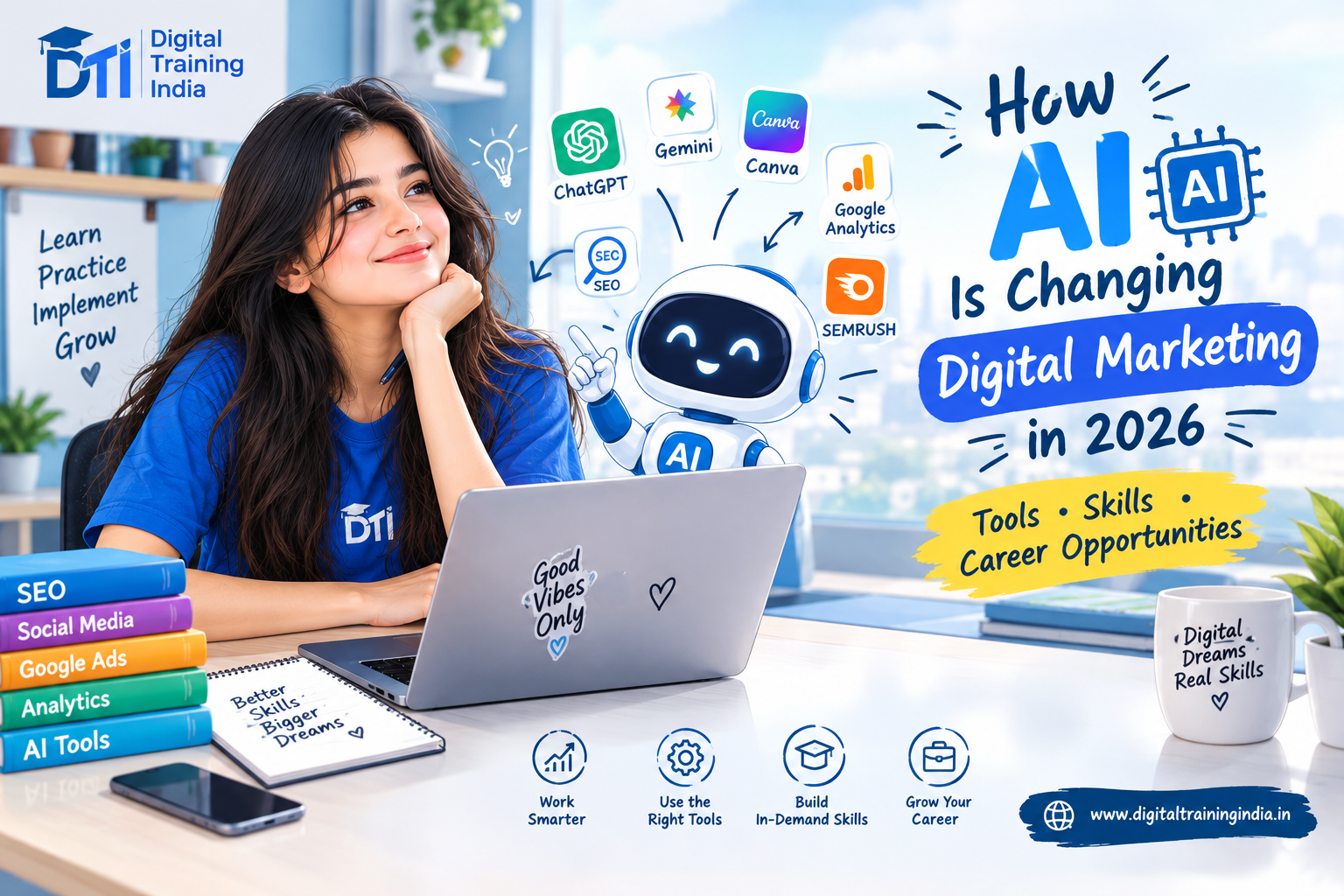
How AI Is Changing Digital Marketing in 2026
Introduction
Digital marketing Training is evolving rapidly, and Artificial Intelligence (AI) is becoming an important part of the industry. Businesses are using AI to understand customer behavior, create content, improve advertising campaigns, Analyse data and automate repetitive tasks.
In 2026, learning digital marketing is no longer limited to understanding SEO or social media. Professionals also need to understand how to use AI tools alongside traditional marketing strategies to improve productivity and make informed decisions.
For students, job seekers, business owners and working professionals, learning AI-powered digital marketing can open new opportunities in the growing digital economy.
1. How AI Is Transforming Digital Marketing
Artificial Intelligence helps marketers process information, identify patterns and complete repetitive tasks more efficiently. However, human creativity, strategic thinking and fact-checking remain essential.
Here are some important areas where AI is making a difference:
Content Marketing: AI tools can help generate blog outlines, social media captions, email drafts and content ideas. Marketers must review and improve the output to ensure accuracy, originality and usefulness.
Search Engine Optimization: AI can assist with keyword research, content analysis, search intent classification and SEO audits. Successful SEO still requires high-quality content, a technically sound website and a good user experience.
Social Media Marketing: Marketers can use AI to brainstorm posts, develop content calendars and analyse engagement patterns across social media platforms.
Paid Advertising: AI-powered advertising systems can help optimise bidding, identify audiences and test creative variations. Campaign performance still depends on suitable objectives, accurate tracking and effective strategy.
Data Analytics: AI can help summarise reports, identify performance trends and support marketing decisions based on available data.
2. Top AI Tools for Digital Marketers
Choosing the right tools depends on your marketing goals, budget and experience level.
ChatGPT
ChatGPT can assist with content planning, keyword clustering, campaign ideas, email drafts, competitor research frameworks and marketing strategies. Always verify facts and review content before publishing.
Google Gemini
Google Gemini can help with brainstorming, research assistance, content development and understanding complex information. Its available capabilities depend on the product and plan.
Canva
Canva offers design tools and AI-assisted features for creating social media graphics, presentations, advertisements and marketing creatives.
Semrush
Semrush provides SEO and digital marketing tools for keyword research, competitor analysis, backlink analysis and website auditing. Its features and limits vary by subscription.
Google Analytics 4
Google Analytics 4 helps marketers understand website traffic, user interactions and conversions. Marketers can use this information to identify which campaigns and channels contribute to business goals.
Google Search Console
Google Search Console provides information about a website's Google Search performance, including clicks, impressions, search queries and indexing issues.
Remember that AI tools support marketing work; they do not replace the need to understand marketing fundamentals.
3. AI and SEO: What Should You Learn?
Search Engine Optimization remains an important digital marketing skill. AI can make research and analysis easier, but ranking a website requires a comprehensive approach.
Students should learn:
- Keyword research and search intent analysis.
- On-page SEO and content optimization.
- Technical SEO, including indexing and crawlability.
- Internal linking and website structure.
- Link earning and backlink quality assessment.
- Google Analytics 4 and Search Console.
- Content quality, helpfulness and user experience.
- AI-assisted research, editing and content workflows.
Instead of producing large quantities of generic AI content, marketers should focus on useful information, original insights, accurate facts and content that meets the audience's needs.
4. Career Opportunities in AI-Powered Digital Marketing
Learning digital marketing with AI tools can help learners prepare for different roles, depending on their skills and practical experience.
Some career options include:
SEO Executive: Works on keyword research, website optimization, technical SEO and organic search performance.
Digital Marketing Executive: Supports SEO, social media, email marketing, analytics and online campaigns.
Performance Marketing Executive: Helps manage paid campaigns, audience targeting, conversion tracking and campaign optimization.
Social Media Executive: Plans content, manages social media accounts and analyses engagement.
Content Marketing Executive: Develops content strategies, blog articles, landing pages and marketing campaigns.
Freelance Digital Marketer: Provides marketing services to businesses, subject to their expertise and client requirements.
Employers may also expect communication skills, analytical thinking, practical experience and the ability to demonstrate results. Completing a course alone does not guarantee employment.
5. Why Practical Digital Marketing Training Matters
Watching tutorials can help you understand concepts, but practical implementation is essential for developing professional skills.
A structured training programme should include website optimization, keyword research, content creation, social media campaigns, advertising fundamentals, analytics and reporting.
Learners should practise using real or supervised sample projects, analyse results and build a portfolio that demonstrates what they can do.
At Digital Training India, learners can explore digital marketing training covering key areas such as SEO, social media marketing, Google Ads, website development, analytics and AI-assisted marketing workflows.
The goal is to connect theoretical knowledge with practical implementation so learners can better understand how digital marketing works in real business situations.
To explore course details, visit https://digitaltrainingindia.in/
6. How to Start Learning AI Digital Marketing
Beginners can follow a simple learning roadmap:
- Understand digital marketing fundamentals and customer behaviour.
- Learn keyword research, on-page SEO and content optimization.
- Practise creating website pages and blog content.
- Explore social media marketing and paid advertising.
- Learn Google Analytics 4 and Google Search Console.
- Use relevant AI tools to improve research and productivity.
- Complete practical projects and document the results.
- Build a portfolio and prepare for internships, jobs or freelance projects.
Consistency matters more than learning dozens of tools at once. Start with the essential skills and gradually expand your knowledge.